Section VII
Plugging the Cotra probabilities into a simple quantitative model of real interest rates predicts very high rates
Section VI used historical data to go from the current real rate to a very crude market-implied forecast of growth rates; in this section, we instead use a model to go from existing forecasts of AI timelines to timeline-implied real rates. We aim to show that under short AI timelines, real interest rates would be unrealistically elevated.
This is a useful exercise for three reasons. First, the historical data is only able to speak to growth forecasts, and therefore only able to provide a forecast under the possibly incorrect assumption of aligned AI. Second, the empirical forecast assumes a linear relationship between the real rate and growth, which may not be reasonable for a massive change caused by transformative AI. Third and quite important, the historical data cannot transparently tell us anything about uncertainty and the market’s beliefs about the full probability distribution of AI timelines.
We use the canonical (and nonlinear) version of the Euler equation – the model discussed in section I – but now allow for uncertainty on both how soon transformative AI will be developed and whether or not it will be aligned. The model takes as its key inputs (1) a probability of transformative AI each year, and (2) a probability that such technology is aligned.
The model is a simple application of the stochastic Euler equation under an isoelastic utility function. We use the following as a baseline, before considering alternative probabilities:
- We use smoothed Cotra (2022) probabilities for transformative AI over the next 30 years: a 2% yearly chance until 2030, a 3% yearly chance through 2036, and a 4% yearly chance through 2052.
- We use the FTX Future Fund’s median estimate of 15% for the probability that AI is unaligned conditional on the development of transformative AI.
- With the arrival of aligned AI, we use the Davidson (2020) assumption of 30% annual economic growth; with the arrival of unaligned AI, we assume human extinction. In the absence of the development of transformative AI, we assume a steady 1.8% growth rate.
- We calibrate the pure rate of subjective time preference to 0.01 and the consumption smoothing parameter (i.e. inverse of the elasticity of intertemporal substitution) as 1, following the economic literature.
Thus, to summarize: by default, GDP grows at 1.8% per year. Every year, there is some probability (based on Cotra) that transformative AI is developed. If it is developed, there is a 15% probability the world ends, and an 85% chance GDP growth jumps to 30% per year.
We have built a spreadsheet here that allows you to tinker with the numbers yourself, such as adjusting the growth rate under aligned AI, to see what your timelines and probability of alignment would imply for the real interest rate. (It also contains the full Euler equation formula generating the results, for those who want the mathematical details.) We first estimate real rates under the baseline calibration above, before considering variations in the critical inputs.
Baseline results. The model predicts that under zero probability of transformative AI, the real rate at any horizon would be 2.8%. In comparison, under the baseline calibration just described based on Cotra timelines, the real rate at a 30-year horizon would be pushed up to 5.9% – roughly three percentage points higher.
For comparison, the 30-year real rate in the US is currently 1.6%.
While the simple Euler equation somewhat overpredicts the level of the real interest rate even under zero probability of transformative AI – the 2.8% in the model versus the 1.6% in the data – this overprediction is explainable by the radical simplicity of the model that we use and is a known issue in the literature. Adding other factors (e.g. precautionary savings) to the model would lower the level. Changing the level does not change its directional predictions, which help quantitatively explain the fall in real rates over the past ∼30 years.
Therefore, what is most informative is the three percentage point difference between the real rate under Cotra timelines (5.9%) versus under no prospect of transformative AI (2.8%): Cotra timelines imply real interest rates substantially higher than their current levels.
Now, from this baseline estimate, we can also consider varying the key inputs.
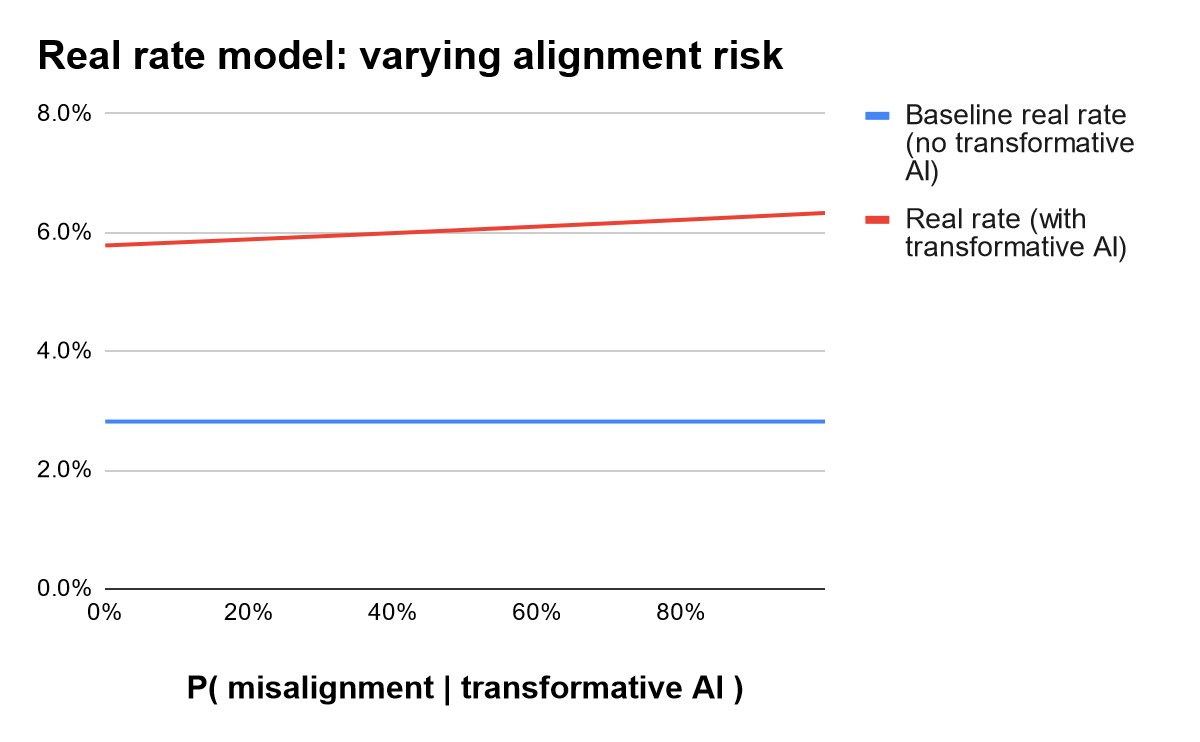
Varying assumptions on P(misaligned|AGI). First consider changing the assumption that advanced AI is 15% likely to be unaligned (conditional on the development of AGI). Varying this parameter does not have a large impact: moving from 0% to 100% probability of misalignment raises the model’s predicted real rate from 5.8% only to 6.3%.
Varying assumptions on timelines. Second, consider making timelines shorter or longer. In particular, consider varying the probability of development by 2043, which we use as a benchmark per the FTX Future Fund.
We scale the Cotra timelines up and down to vary the probability of development by 2043. (Specifically: we target a specific cumulative probability of development by 2043; and, following Cotra, if the annual probability up until 2030 is x, then it is 1.5x in the subsequent seven years up through 2036, and it is 2x in the remaining years of the 30-year window.)
As the next figure shows and as one might expect, shorter AI timelines have a very large impact on the model’s estimate for the real rate.
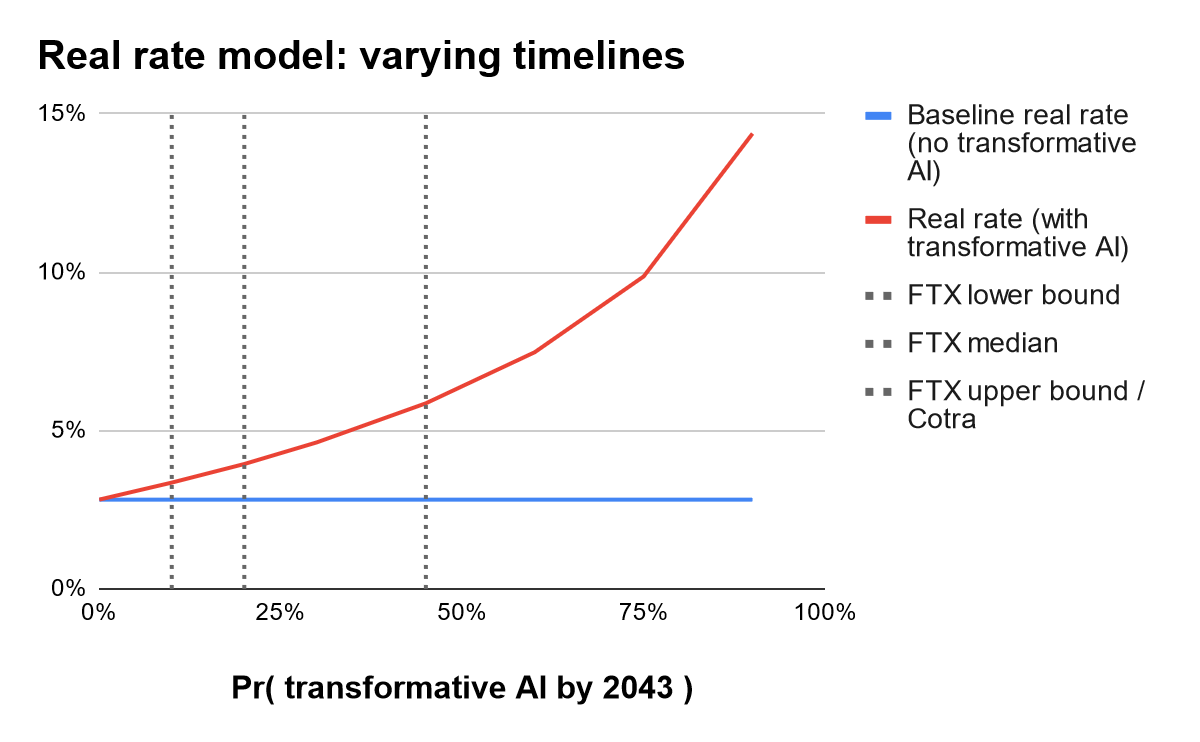
- The original baseline parameterization from Cotra corresponds to the FTX Future Fund “upper threshold” of a 45% chance of development by 2043, which generated the 3 percentage point increase in the 30-year real rate discussed above.
- The Future Fund’s median of a 20% probability by 2043 generates a 1.1 percentage point increase in the 30-year real rate.
- The Future Fund’s “lower threshold” of a 10% probability by 2043 generates a 0.5 percentage point increase in the real rate.
These results strongly suggest that any timeline shorter than or equal to the Cotra timeline is not being expected by financial markets.